In tough industrial settings, your floor isn’t just something you walk on, it’s a working part of your operation. Industrial epoxy coatings are far stronger than regular paint because they bond tightly to the concrete and can handle heavy impact. But even the best industrial epoxy coating can fail if the concrete isn’t prepped correctly first.

Peeling line striping on an industrial floor.
Concrete naturally resists coatings, so if you don’t properly grind or profile the surface, the epoxy has nothing to grab onto. And here’s the part most contractors gloss over: skip the prep, and even the most expensive “super epoxy” turns into a fancy sticker that will peel right off.
And paint on concrete doesn’t stand a chance.
Why Concrete Hates Paint (and Why an Industrial Epoxy Coating is the Perfect Match)
Think of your concrete floor as a living, breathing surface. It might look solid and still, but it’s porous, chemically active, and constantly moving. Here is why standard paint fails the “compatibility test” and why epoxy is an industrial-grade solution.
- The “Sweaty Skin” Problem (Moisture)
- The Paint Fail: Concrete is like a giant sponge full of microscopic holes. Moisture from the ground is constantly trying to “breathe” out of it. When you put paint on top, it’s like wearing a plastic raincoat while running, the sweat (moisture) gets trapped, builds up pressure, and eventually pushes the paint off in big, ugly bubbles.
- The Epoxy Win: We open the concrete’s pores via shot blasting or diamond grinding so our breathable epoxy can “root” deep inside. This creates an engineered bond that stays anchored even when faced with upward moisture pressure. It doesn’t just sit on the floor; it becomes part of it, allowing the slab to breathe without ever losing its grip.
- The “Dusty Sticker” Problem (Laitance)

Blackwell’s, Inc. associate using a shot blaster to profile the concrete floor in preparation for an epoxy coating
- The Paint Fail: Every concrete slab has a thin, invisible layer of brittle dust on top called laitance. If you paint over it, you aren’t sticking to the floor—you’re sticking to the residual from the hydration process. The moment a heavy forklift drives over it, the dust layer snaps, and your paint peels off like a cheap sticker.
- The Epoxy Win: We use diamond grinders and shot blasting to “exfoliate” the concrete, removing that laitance layer and revealing the solid rock underneath. The epoxy floor coating then grabs onto that rock with a death grip that won’t let go.
- The “Turning to Soap” Problem (High pH)
- The Paint Fail: Concrete is naturally very “basic” (the opposite of acidic) because of the lime inside it. Many paints react with this lime in a process that literally turns the bottom layer of paint into a gummy soap. You can’t expect a floor to stay put if the glue holding it down is turning into dish detergent!
- The Epoxy Win: Epoxy is chemically “chill.” It doesn’t react with lime in the concrete. Once it cures, it stays solid and stable like plastic, unaffected by the chemistry of the slab beneath it.
- The “Yoga” Problem (Movement)
- The Paint Fail: Concrete isn’t as rigid as it looks; it expands when it’s hot and shrinks when it’s cold. Most paints are brittle. When the floor does its “morning stretch,” the paint can’t keep up. It develops tiny cracks, allowing dirt and oil to crawl underneath and lift the rest of the paint.
- The Epoxy Win: Industrial epoxy is tough but has just enough “give” to move with the floor. It acts as a seamless, flexible shield that keeps your floor looking perfect through every season.
It’s Not Just a Coating—It’s an Upgrade with Epoxy
Think of it this way: paint just “sits” on top of your floor like a tablecloth, but an industrial epoxy coating moves in.
When you pour epoxy, it doesn’t just sit on top. It dives deep into the tiny, open pores of the concrete. As it cures, it hardens inside those pores, creating a mechanical bond. This means the epoxy and the concrete essentially become one single, inseparable bonded unit.
You aren’t just putting a thin film over the floor; you’re creating a seamless, armor-plated shield that reinforces the slab. Because it becomes a physical part of the floor, epoxy can handle the punishing weight of heavy machinery that would leave ordinary paint in tatters within weeks.
Engineering Out the Obstacles: Mitigating the Risks of a Surface That Never Rests
Even the strongest epoxy isn’t magic. It’s still vulnerable to those same heavy forces if it isn’t installed correctly. Our goal is to mitigate the natural risks of the concrete while engineering out the obstacles created by concrete’s “living, breathing” personality.
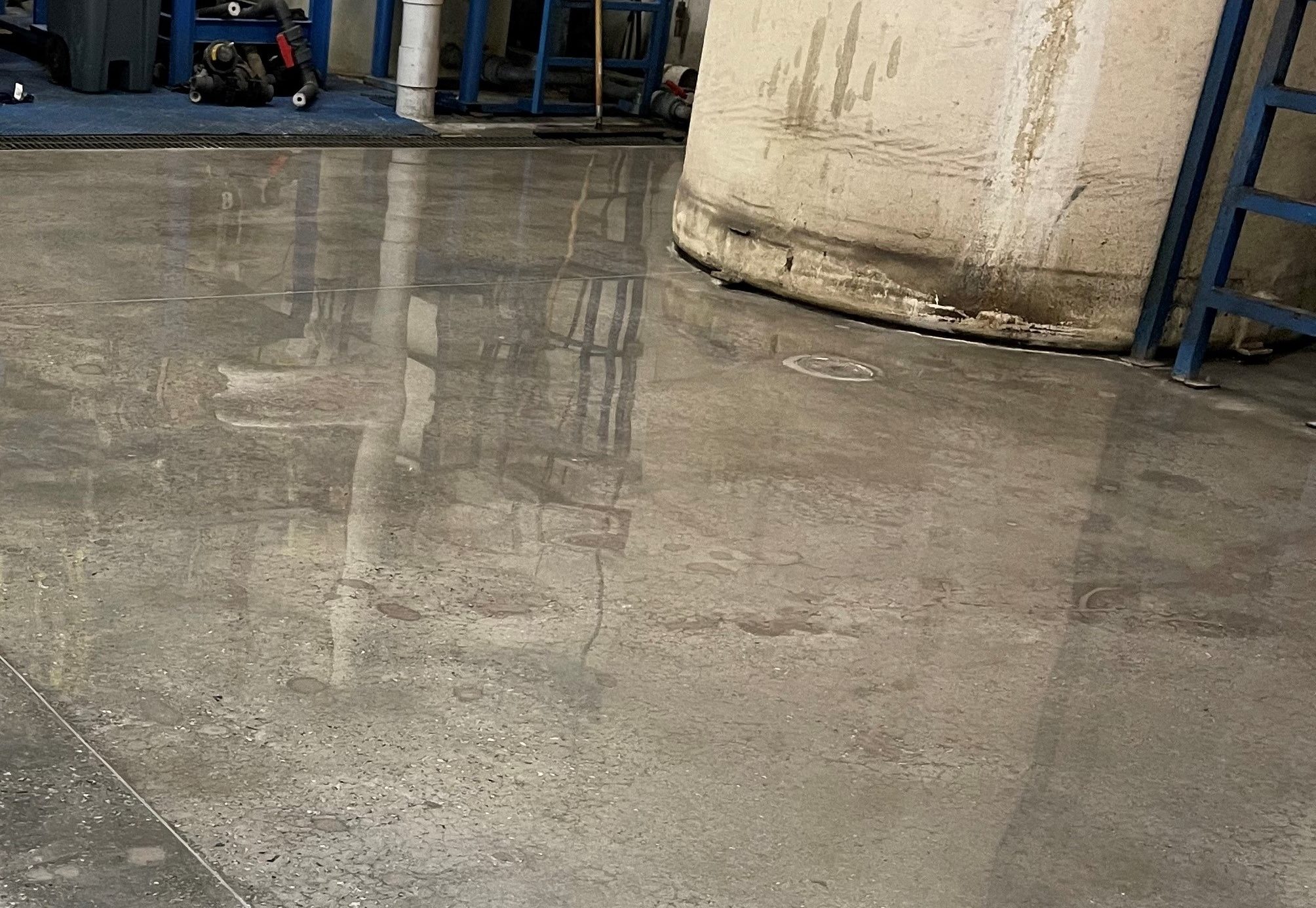
Think of it this way: to the untrained eye, a smooth, shiny concrete floor looks perfect. But to a pro, that floor is “tight.” Its pores are sealed shut, leaving the epoxy with nothing to grab onto. If you just pour epoxy on top, it’s like trying to tape a brick to a window—it won’t hold for long.
To fix this, we use heavy machinery to “open” the floor back up. By removing the smooth top layer, we engineer out the grip problems and mitigate the risk of peeling. This allows the epoxy to dive deep into the slab and lock in for good.
The Solution: Giving the Floor “Teeth”

“Tight” concrete (left and upper right corner) and with “Teeth” (center) after shot blasting to open the concrete in preparation for epoxy coating of line stripes
To fix a tight slab, we use Shot Blasting (or media blasting) and Diamond Grinding and often a combination of both. This process fires abrasive metal shot at the floor to strip away contaminants and create an “Anchor Pattern.” Formally known as a Concrete Surface Profile (CSP), these “teeth” allow the epoxy to physically lock into the floor. For a smoother look we can also use Diamond Grinding.
Dust-Free & Self-Contained: How It Works
Modern shot blasting is a self-contained system designed for clean, indoor operation. It isn’t the messy nightmare people often imagine:
- Impact & Instant Recovery: As the metal shot hits the floor, it immediately bounces back into a recovery chamber.
- The Smart Separator: The machine automatically separates the heavy metal shot from the fine concrete dust.
- Medical-Grade Vacuuming: A high-powered, sealed dust collection system captures every speck of debris (99.97 % HEPA), ensuring a “white-glove” environment for your new installation.
Choosing the right industrial epoxy coating is only half the battle

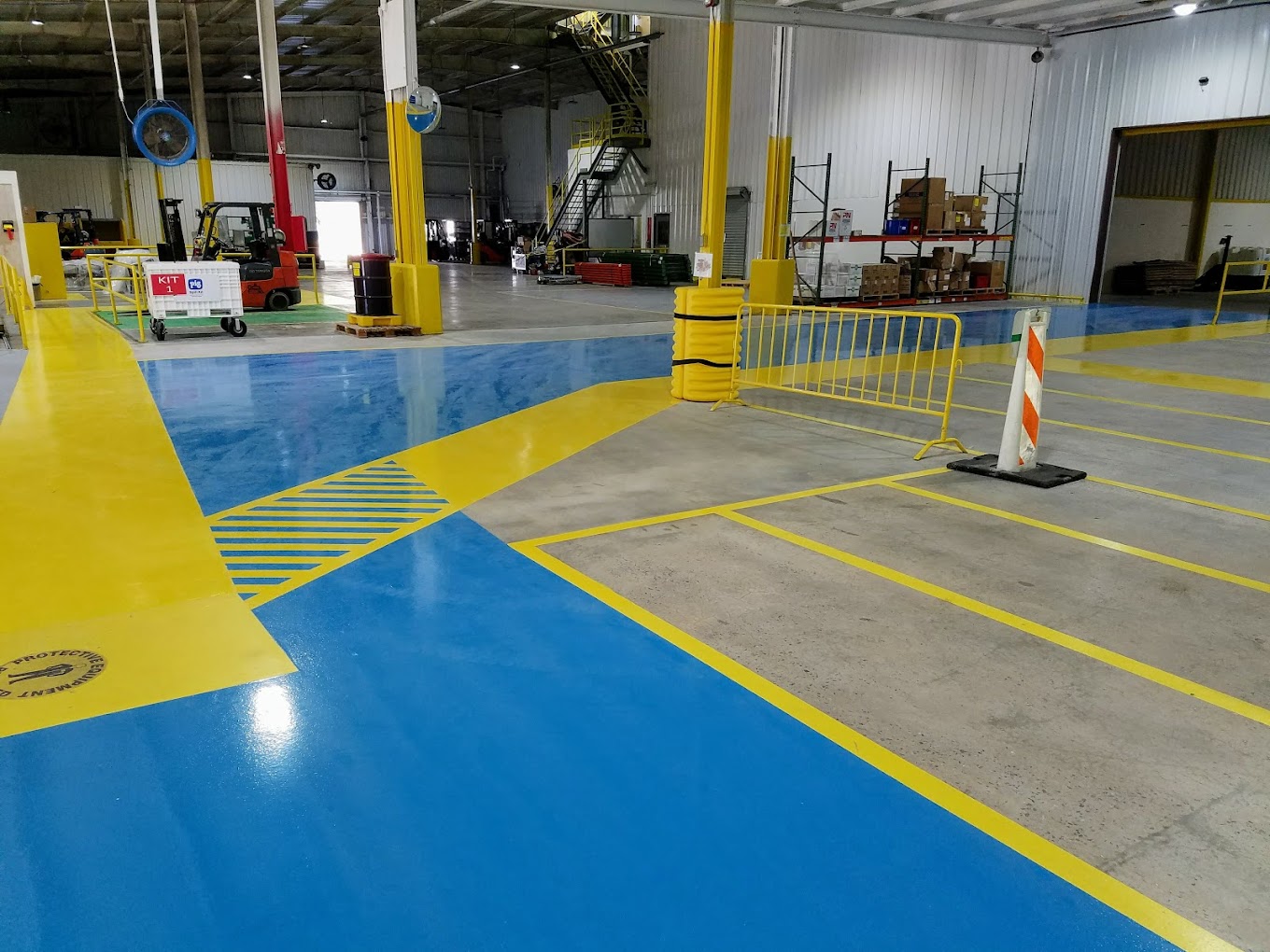
Finished line striping with 2 coats of epoxy and a topcoat of abrasion resistant urethane
Ultimately, choosing the right material is only half the battle. If you invest in high-performance industrial epoxy coatings without investing in the “teeth” of a shot blasted or grinded surface, you are essentially gambling on a surface-level bond. By prioritizing mechanical preparation, you move beyond temporary aesthetics and into true industrial durability, ensuring your floor remains as crisp and anchored on year ten as it was on day one.
In the end, while standard paint may be tempting for its low cost and ease of application, it is fundamentally incompatible with the physics of a hardworking concrete floor. Even using paint just for industrial safety stripes isn’t just a maintenance task, it’s a cycle of inevitable failure.
To get results that last, you must stop thinking about “painting” the floor and start thinking about “engineering” it.
https://www.blackwells-inc.com/resinous-flooring-services/

Mike enriches Blackwell’s, Inc. with his extensive experience and unwavering dedication. Drawing on his tenure as a University of Georgia Extension Agent and Director, he expertly manages diverse responsibilities such as marketing, fleet management, and design. A pilot, diver, horseman, and tree farmer in his personal life, Mike is anchored by his strong Christian faith and the joy of his grandchildren, making him a truly vital team member.